




















“Humanity has long disregarded the intellect. People have denied themselves the ability to think, reason independently. That has rendered humans helpless victims of the devastating mind. The once sovereign state of human beings has fallen into abject slavery to the mind’s endless desires and demands,” says the Indian philosopher Avula Parthasarathy.
Artificial Intelligence (AI) is a tool where it analyzes data from credible sources, generating it into short, wordy answers.
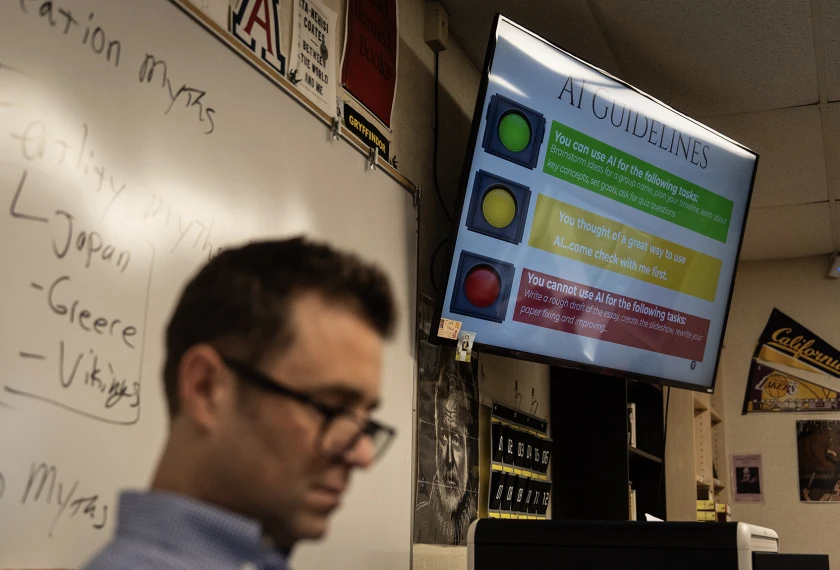
AI weakens critical learning in schools and core learning abilities. School is vital to students, since it strengthens relationships between their teachers and creates a safe environment for them to learn.
AI’s impact on students has increased over the last school year.
According to Jennifer Vilcarino and Lauraine Langreo of Education Week, they state in their article that “Eighty-five percent of teachers and 86% of students used AI in the 2024-25 school year.”
Cheating has also been an important issue due to AI. Due to the no phone policy during school hours, students have gotten sneakier on how to futilely utilize their phone behind their teachers backs.
Blanka Kilmova and Marcel Pikhart explain the several ways in their article posted on the National Library of Medicine: “In many cases, students turn to AI to find quick answers, automate processes, or personalize their learning experiences.”
This comment illustrates that depending on AI is not always the smartest idea because it may help students to do their homework, but it reduces their learning experiences. AI also can be ineffective when using it because it isn’t always accurate and can generate fake answers.
Mr. Tonnesen, the instructional technology specialist here at Landstown High School stated that, “I can see a lot of people just jumping into it as quick go-tos at the last minute when they have something due for.”
He went on to explain that jobs, such as coding, would be useless in the future now that we have AI programming everything for them.
“So those people going into coding right now, they may not have as many job opportunities as they thought they were going to have,” says Tonnesen.
In schools, part of the learning comes from knowledge and understanding the topics that you learned. If the bot program is condensing it for you, you’ll never learn anything.
Mrs. Sanderlin, the other instructional technology specialist here at Landstown High School, highlighted that “It’s still our job to read it and process the information and critically think to see whether what they’re actually giving us makes sense or is real or legit.”
Sanderlin’s note shows how we can’t always rely on the answers AI spits out at us because it’s a computer-based program, where it pulls information from certain sources. Double checking and thinking about whether we’re getting precise answers is key when using Artificial Intelligence.
Although AI weakens ethics in school and in reality, it can be helpful in other ways. Lateral reading is useful when using AI because you’re looking back at the stuff you imputed into the program and comparing it with the answers AI has provided for you.
This solution would help students understand the subjects they’re learning at school, making AI a useful tool for them instead of relying on it.
Despite the increase of the usage of AI globally and in schools, AI takes over learning for humans because it’s doing the work for them, as it weakens your learning and relationships inside or outside of school.
Altogether, we can create effective approaches on how to fix this problem by teaching how to use AI properly in schools or in reality, encourage when to use AI, and promote critical thinking in classrooms.